Notes from the Guarantees for Climate Resilience Webinar
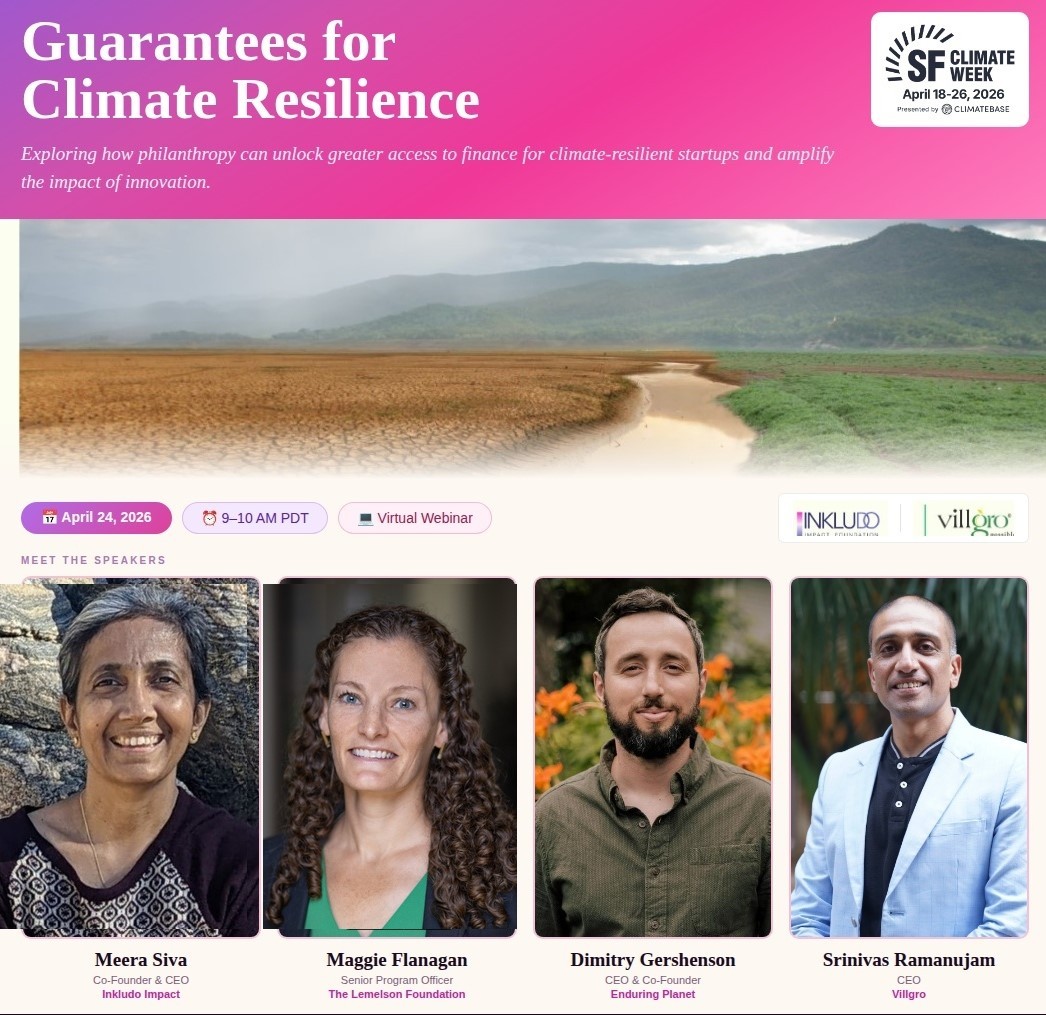
Speakers:
Maggie Flanagan, The Lemelson Foundation - Strengthening innovation ecosystems in India & Kenya
Dimitry Gershenson, Enduring Planet - Working capital & climate finance for startups
Srinivas Ramanujam, Villgro - Scaling social enterprises in agriculture, climate & circularity
Meera Siva, Inkludo Impact - Addressing systemic gaps in impact enterprise financing
Central Theme: How philanthropy, impact investors, and ESOs can unlock debt capital for climate startups — through guarantees and first-loss structures.
Key Discussion Highlights
Why Debt Capital Matters Now
Equity markets have softened significantly for climate startups, pushing debt to the forefront of the capital stack. Entrepreneurs often misunderstand the true cost of equity. Debt is frequently the more capital-efficient choice. Also, much of the government funding available is reimbursement-based requiring upfront capital that creates financing needs.
Catalytic Capital Should Unlock Markets
Catalytic capital's purpose is to unlock follow-on financing from private markets, not just provide concessional terms. Being the first mover to do what it takes to bring in follow-on private financing is a key role it can play. It is most effective when it enables commercial participation rather than substitutes for it. Guarantees, first-loss capital, concessional debt, and blended structures can reduce barriers for lenders and investors, helping them enter sectors they may otherwise perceive as too early or too risky.
Perception of Risk Often Exceeds Actual Risk
Lenders unfamiliar with climate models often conflate risk from unrelated sectors, inflating hesitation beyond what the fundamentals warrant. ESOs and expert intermediaries are crucial translators making climate business models legible to capital providers. There is a need for stronger underwriting frameworks, market education, and intermediaries that can translate sector opportunities into investable credit propositions. Guarantees serve a dual role: reducing both perceived risk and providing real downside protection when lenders step into unfamiliar territory.
Small Catalytic Interventions Can Drive Significant Outcomes
Relatively modest guarantees or early debt support enabled enterprises to unlock larger pools of capital, accelerate growth, and create meaningful impact over time. This reinforced the importance of early risk-sharing mechanisms in helping promising ventures reach scale. Guarantees have historically served large infrastructure projects but haven't yet scaled to smaller climate enterprises. Indian lenders enjoy comfortable margins (~5% spreads) with lower-risk borrowers, reducing incentive to venture into unfamiliar climate sectors.
The pipeline-building process is slow - Villgro spent ~3 years developing enough deals to shift lenders from backing individual transactions to endorsing entire product categories.
Intermediaries and Ecosystem Enablers Matter
Credit expertise is specialized. When organizations without credit expertise attempt direct lending, loss rates are high and processes unprofessional Hence the better model is to invest in building a strong intermediary layer of lenders and funds that can outlast any single funder's interest in a sector. These intermediaries accumulate data and eventually operate without needing credit enhancement. Intermediary lenders persist even when foundation priorities shift
Open Questions:
● How to scale guarantees beyond bespoke solutions to commoditized products in climate sectors?
● Mechanisms for matching technical assistance pre and post-investment with right incentives.
● Strategies for coordinating catalytic capital given its scarcity.
Key Takeaways for the Ecosystem
There are four broader opportunities:
1. Build more debt-ready climate enterprises
2. Expand guarantee and risk-sharing products for underserved sectors
3. Strengthen specialist intermediaries that connect enterprises with capital
4. Use catalytic capital strategically to crowd in private finance.
" height="39.997200000000014px" id="c7taZDl_g" width="39.99719999999991px"/><path d="M 4.497 0 C 5.69 0 6.834 0.474 7.678 1.317 C 8.521 2.161 8.995 3.305 8.995 4.497 L 8.995 9.744 L 5.996 9.744 L 5.996 4.497 C 5.996 4.1 5.839 3.718 5.557 3.437 C 5.276 3.156 4.895 2.998 4.497 2.998 C 4.1 2.998 3.718 3.156 3.437 3.437 C 3.156 3.718 2.998 4.1 2.998 4.497 L 2.998 9.744 L 0 9.744 L 0 4.497 C 0 3.305 0.474 2.161 1.317 1.317 C 2.161 0.474 3.305 0 4.497 0 Z" fill="transparent" height="9.744300000000003px" id="T3uLNsg3z" stroke-dasharray="" stroke-linecap="round" stroke-linejoin="round" stroke-width="1.49912" stroke="rgb(243, 46, 200)" transform="translate(18.5 17)" width="8.994699999999995px"/><path d="M 2.998 0 L 0 0 L 0 8.995 L 2.998 8.995 Z" fill="transparent" height="8.994700000000002px" id="z3i_It9d6" stroke-dasharray="" stroke-linecap="round" stroke-linejoin="round" stroke-width="1.49912" stroke="rgb(243, 46, 200)" transform="translate(12.503 17.75)" width="2.9983000000000004px"/><path d="M 1.499 2.998 C 2.327 2.998 2.998 2.327 2.998 1.499 C 2.998 0.671 2.327 0 1.499 0 C 0.671 0 0 0.671 0 1.499 C 0 2.327 0.671 2.998 1.499 2.998 Z" fill="transparent" height="2.9983000000000004px" id="UUvHjl6Mb" stroke-dasharray="" stroke-linecap="round" stroke-linejoin="round" stroke-width="1.49912" stroke="rgb(243, 46, 200)" transform="translate(12.503 12.503)" width="2.9983000000000004px"/></svg>)