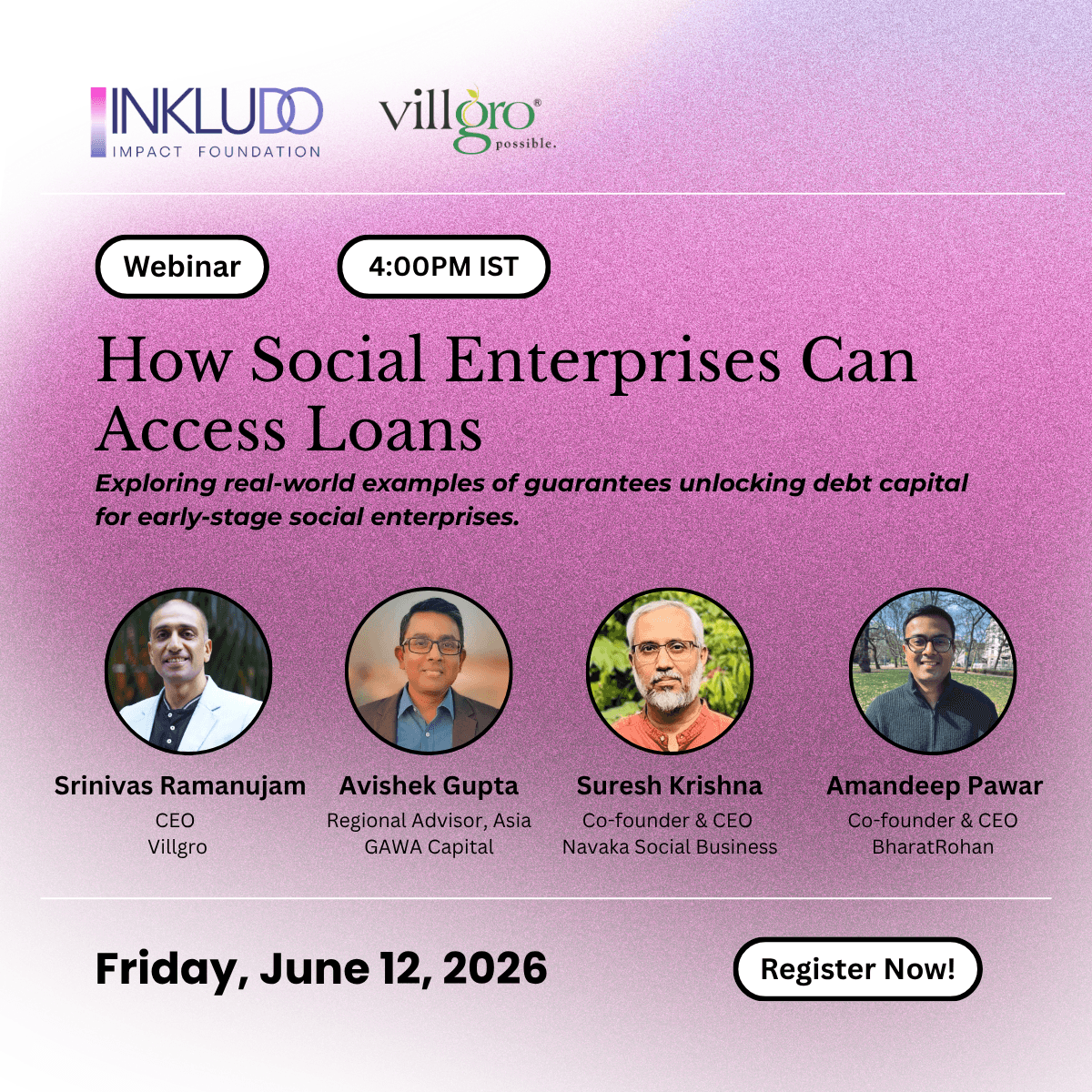
Notes from the Webinar on Loan access to Social Enterprises in India
Speakers:
Avishek Gupta, Regional Advisor at GAWA Capital and was previously Managing Director & CEO at Caspian Debt.
Amandeep Panwar, co-founder and CEO of Bharat Rohan
Suresh Krishna, co-founder and CEO of Navaka Social Business Fund
Srinivas Ramanujam, CEO - Villgro Innovation Foundation
Webinar Recording: Linked here.
Central Theme: How guarantees, blended finance, and stronger internal readiness can help early-stage social enterprises move from grant dependence to bankable, debt-ready businesses.
Key Discussion Highlights
1. Guarantees as a Catalyst for Smaller, Impact-Led Loans
Guarantee structures, such as first-loss guarantees, help de-risk early-stage impact enterprises, making them lendable even at modest ticket sizes.
By leveraging guarantees, impact funders can unlock credit for entrepreneurs who might otherwise be sidelined by traditional lenders, expanding access to capital for grassroots solutions.
Early stage lenders like Caspian Debt by lending a smaller ticket size to Bharat Rohan has successfully created pathways for future lending as the enterprise grows.
2. Debt and Equity Are Complementary Tools for Scaling Impact
Impact entrepreneurs need to balance debt and equity, recognizing that each plays a distinct role: equity fuels growth and signals future potential, while debt enforces cash-flow discipline and immediate sustainability.
A strategic mix of the two can accelerate impact without overloading an enterprise's cash cycle or diluting ownership prematurely, enabling more resilient scaling.
Bharat Rohan's journey from grant reliance to debt readiness illustrated how embracing unit economics and internal controls facilitated successful debt financing.
3. Internal Controls and Data Readiness Are Prerequisites for Fundability
Transparent, well-documented internal systems like an accurate MIS, traceability of transactions, and sound governance, are prerequisites for impact enterprises seeking institutional finance.
Building a data room and internal discipline reduces due-diligence friction and increases lender trust.
4. Ecosystem Maturity Requires Simpler, Smaller-Scale Blended Finance
Large impact-capital flows are often hindered by regulatory and operational complexity; fostering growth at the mid and smaller-enterprise level requires more flexible, simplified structures.
The evolution of blended finance exhibits how sophisticated financing structures can be designed to be accessible and scalable for smaller transactions.
Current impact financing tends to favor large, high-profile projects; panelists emphasized the need for more funds focused on lower-ticket, innovative enterprises, with blended finance tools adapted accordingly.
ESOs like Villgro play a role beyond providing data and guarantees. They help lenders build sector familiarity, speed up decision-making and make smaller-ticket lending less operationally heavy.
5. Mental Readiness: Shifting from a Grant Mindset to Sustainable Operations
Entrepreneurs benefit from a mindset shift, seeing debt as a tool for immediate sustainability, not only as a path tied to long-term impact or future grant funding.
This shift improves reporting discipline, operational rigor, and investor trust, ultimately making impact ventures more resilient and scalable.
Bharat Rohan's founders found that managing cash flow and internal controls enabled their transition to structured debt and listing readiness and strengthened their negotiating position with customers.
" height="39.997200000000014px" id="c7taZDl_g" width="39.99719999999991px"/><path d="M 4.497 0 C 5.69 0 6.834 0.474 7.678 1.317 C 8.521 2.161 8.995 3.305 8.995 4.497 L 8.995 9.744 L 5.996 9.744 L 5.996 4.497 C 5.996 4.1 5.839 3.718 5.557 3.437 C 5.276 3.156 4.895 2.998 4.497 2.998 C 4.1 2.998 3.718 3.156 3.437 3.437 C 3.156 3.718 2.998 4.1 2.998 4.497 L 2.998 9.744 L 0 9.744 L 0 4.497 C 0 3.305 0.474 2.161 1.317 1.317 C 2.161 0.474 3.305 0 4.497 0 Z" fill="transparent" height="9.744300000000003px" id="T3uLNsg3z" stroke-dasharray="" stroke-linecap="round" stroke-linejoin="round" stroke-width="1.49912" stroke="rgb(243, 46, 200)" transform="translate(18.5 17)" width="8.994699999999995px"/><path d="M 2.998 0 L 0 0 L 0 8.995 L 2.998 8.995 Z" fill="transparent" height="8.994700000000002px" id="z3i_It9d6" stroke-dasharray="" stroke-linecap="round" stroke-linejoin="round" stroke-width="1.49912" stroke="rgb(243, 46, 200)" transform="translate(12.503 17.75)" width="2.9983000000000004px"/><path d="M 1.499 2.998 C 2.327 2.998 2.998 2.327 2.998 1.499 C 2.998 0.671 2.327 0 1.499 0 C 0.671 0 0 0.671 0 1.499 C 0 2.327 0.671 2.998 1.499 2.998 Z" fill="transparent" height="2.9983000000000004px" id="UUvHjl6Mb" stroke-dasharray="" stroke-linecap="round" stroke-linejoin="round" stroke-width="1.49912" stroke="rgb(243, 46, 200)" transform="translate(12.503 12.503)" width="2.9983000000000004px"/></svg>)